

Vang Bamar 200


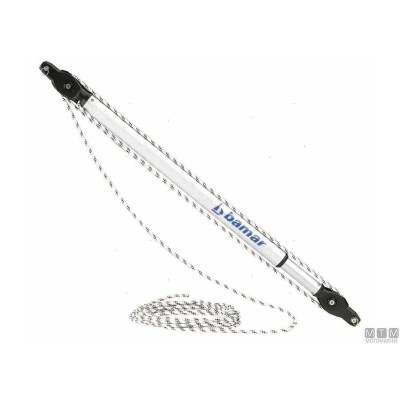
Mechanical Kicker with Spring
The Bamar mechanical kicker features a stainless steel internal spring that efficiently lifts the mast. Constructed from anodized aluminum, it includes specialized connection terminals that integrate pulleys, creating a compact line tackle system. You can control the line from the cockpit or secure it to the kicker using additional tackle. The spring mechanism allows for easy and precise push adjustment simply by rotating the upper tube or terminal.
This kicker is available in five models, designed for boats ranging from 30 to 62 feet, allowing you to customize its length during installation to suit your specific requirements.
The kicker comes in anodized aluminum alloy finishes of either silver or black, consisting of two telescopic tubes. These tubes are equipped with specialized connection terminals featuring integrated pulleys, enabling a streamlined and efficient line tackle system. The line can be directed towards the cockpit or secured to the kicker itself with additional tackle and a halyard. The built-in spring mechanism provides precise adjustment of the kicker's push by simply rotating the tube or upper terminal.
How to Use the Kicking Strap or Vang
When sailing, one of the most crucial tools for adjusting the main sail is the vang, also known as the kicking strap. In nautical terminology, a line and pulley system is often referred to as a kicker or kicking strap, while a rod or hydraulic system is called a vang. However, these terms are often used interchangeably, even among crew members on the same vessel.
To understand the purpose of the vang, we first need to consider how we adjust the mainsail. The most common adjustment options for sailors are the halyard and the car. Both adjust the angle of attack, but the halyard also changes the shape of the sail. Loosening the halyard allows the mast to extend, altering the angle of attack and causing it to lift, which introduces twist at the trailing edge.
When sailing in the wind (meaning deeper than a beam reach), we may want to loosen the halyard to present the sail more effectively to the wind. However, if this is done without applying vang, the mast will rise, causing excessive twist on the sail and reducing its power.
To prevent this, while loosening the halyard, we must ensure that the vang remains well-adjusted. This keeps the mast down and maintains the tension on the trailing edge while the mast is relaxed.
It is important to note that if the vang is too tight, especially after sailing upwind, it should be adjusted when changing course to avoid over-tensioning. The loads can be significant, and failing to monitor and adjust may lead to breakage.
Furthermore, when there is considerable tension in the vang, releasing it while running through a jammer or clutch can be challenging. If the vang is under load in a jammer, you will need to transfer the load to the winch first, using a winch handle.
As the primary reason for releasing the vang is to quickly deactivate the mainsail, it is advisable to keep the weight of the vang on a winch with the jammer open when sailing on a reach or deeper. Many captains position a crew member near the vang under these conditions, often referred to as being on “vang watch.” This allows for a quick release of the vang in case of a hitch or if the helm turns too much into the wind while the yacht carries too much sail area for that course.
When sailing upwind, the vang should be adjusted firmly by hand. If the boat is racing and approaching overpowering conditions, the vang should be kept on a winch, with a crew member ready to release it if necessary.
Adjusting the vang or tensioning an adjustable backstay significantly impacts the handling and speed of the yacht, effectively deactivating the sail plan, particularly the mainsail.
During the lowering of the mast, loosening the vang is a critical part of the process. Failing to do so can hinder your ability to deactivate the mainsail during lowering and prevent the mast from rising, which it would naturally do as the lowering line is tensioned.
Specifications:
- Rope Diameter: 8 mm
- Recommended Boat Size - Max: 44 feet
- Recommended Boat Size - Min: 35 feet
- Maximum Length: 2000 mm
- Purchase Ratio: 4:1
- Spring Force: 1760 N
- Pin Diameter: 12 mm
- Stroke: 250 mm
- Length A: 2000 mm
- Weight: 6000 g